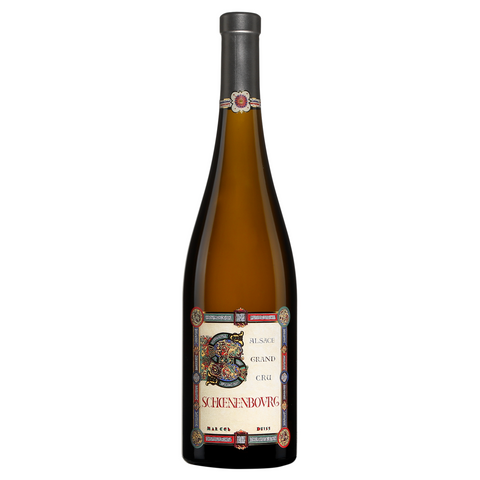
Domaine Marcel Deiss 'Schoenenbourg' Grand Cru White 2016
Order by case of 6 and get a better price.
White

2016

Alsace

Alsace

Alsace Blend

Biodynamic


Grape
Pinot Blanc, Pinot Gris, Pinot Noir, Sylvaner, Muscat d'Alsace (white and red), Muscat à Petit Grain, Riesling, Gewurtztraminer, Traminer, Chasselas, Chasselas Rose.
Schoenenbourg is the gem of all the Riquewihr vineyards. This site has been the birthplace of the greatest wines in the region and is the reason for Riquewihr’s almost universal renown. The combination of a light, airy topsoil and a fertile clay subsoil, with good water retention, explains why terroir dominates varietal in Schoenenbourg.
Schoenenbourg does another fascinating trick. Among the Deiss wines, Altenberg is the wine we sometimes use to pair with deserts (just the fruit based ones such as pear or apple tarts as it’s not sweet enough for others.) And though Schoenenbourg is higher in residual sugar than Altenberg, routinely around 70 g/l, it doesn’t come across as sweet enough for deserts. This is what the Deiss’ website suggest: Shellfish and food rich in iodine (lobster, spiny lobster). Fattened chickens, capons and noble fishes, and caviar after a decade of aging.
Tasting notes
The wines display an undeniable aptitude for aging, richness, extraordinary body, and a very unique expression: peppered or even smoky nose, a backbone beneath the fullness, a mineral expression that may remain hidden in youth but gives fossilized notes with time. Thanks to the potential for noble rot in this area, residual sugars are usually quite high. Schoenenberg is one of the greatest wines made in the Alsatian terroirs.
More About The Winery
Domaine Marcel Deiss is one of Alsace’s most distinctive and influential estates, located in the village of Bergheim. The Deiss family has been growing vines since the 18th century, but the modern identity of the domaine was shaped by Jean-Michel Deiss, who redefined the estate with a strong focus on terroir expression and traditional Alsatian practices. Today, he works alongside his son Mathieu Deiss.
The estate farms around 30 hectares across Bergheim and surrounding villages, including several Grand Cru sites. All vineyards are cultivated organically and biodynamically, with meticulous attention to soil life and biodiversity. The philosophy is centered on expressing the identity of each vineyard rather than highlighting individual grape varieties.
Domaine Marcel Deiss is especially known for reviving the traditional Alsatian practice of complantation, where multiple grape varieties are planted together in the same parcel, harvested at the same time, and vinified as a single wine. This approach enhances complexity and allows the terroir to take precedence over varietal character.
The wines are known for their texture, depth, and strong mineral backbone, ranging from accessible Alsace bottlings to highly expressive lieux-dits and Grand Cru wines. Domaine Marcel Deiss is widely regarded as a benchmark producer for terroir-driven, biodynamic wines in Alsace.